Hey there, let’s talk about something that’s probably in half the fabrics you’re wearing right now—polyester covered yarn, or PCY for short. I’ve been in the PCY game for over a decade, running this supplier gig, and I still get questions all the time from customers, from small boutique clothing makers to big sportswear brands: “How do you actually make this stuff?” It’s not just a random wrap of thread around another thread—there’s a whole process that’s equal parts precise engineering and good old trial and error, and I’m gonna break it down like I do for my new hires when they first walk through the factory doors. Polyester Covered Yarn

First off, let’s get on the same page about what PCY even is, ‘cause if you don’t know that, the rest sounds like gibberish. Basically, it’s a core yarn wrapped tightly in a layer of polyester filament—so you get the best of both worlds: the softness and stretch of the core, plus the durability, wrinkle resistance, and shape retention of polyester. That’s why it’s used for everything from stretch jeans and leggings to socks, even upholstery fabric. The core can be all sorts of stuff, right? Most common is spandex (or Lycra, if you know that brand name—we avoid the trademark, call it spandex) ‘cause that’s what gives it the stretch. But sometimes we use nylon core for extra softness, or even cotton if a customer wants a stretchy cotton blend for tees. But today we’re focusing on the PCY that leaves our doors, so let’s start at the very beginning: the raw materials.
We don’t cut corners here, ‘cause garbage in equals garbage out. First, we get our spandex core yarn from trusted suppliers that test every roll for consistency—you can’t have a core that stretches more in one spot than another, that messes up the whole wrap. The polyester filament? We use 100% virgin polyester, no recycled stuff unless a customer specifically asks for it (and we do have that option, shoutout to the eco-conscious brands). Virgin polyester is sturdier, has less lint, and holds its shape way better. We buy it in big spools—like, huge, heavy ones that take two guys to lift—each with thousands of yards of filament.
Now, the actual making starts with prepping both yarns. First, we have to condition them, ‘cause polyester and spandex hate being too dry or too humid. If they’re static-y, they’ll snap or tangle during wrapping, which is a nightmare. We run both yarns through humidity-controlled rooms for 24 hours before they even touch the machines. Then we wind them onto smaller, more manageable spools—wait, no, actually we use “creels” to hold multiple large spools at once. That’s important ‘cause if you have to stop every time a spool runs out, you waste time and the yarn has a splice that’s weak. Our creels hold up to 20 spools at a time, so we can run for hours nonstop.
Alright, time for the main event: the wrapping machine. This is where PCY is born, and it’s a piece of equipment that’s evolved a lot over the years. We used to use old single-end machines that only made one spool at a time, but now we have multi-end machines that crank out like 12 at once—faster, more consistent. Here’s how it works, step by step, like I’m showing you right next to the machine: the core yarn comes straight from the creel, goes through a tensioner that keeps it tight but not so tight it breaks. If the tension is off, the core will be too loose and the polyester wrap will pucker, or too tight and the core stretches permanently, ruining the stretch. That tensioner is one of those parts that’s adjusted by eye—our lead operator, Maria, has been doing this for 15 years, she can tell if the tension is off just by listening to the hum of the machine.
Then, the polyester filament—wait, that’s a continuous strand, right? It’s not twisted like yarn, it’s a flat filament. It comes from its own creel, gets threaded through a guide eye, and then the magic happens: the core is held stationary, and the polyester filament is wrapped around it like a ribbon. Wait, no, actually there’s two types of wrapping: single cover and double cover. Single cover is one layer, double cover is two layers, one opposite direction so it’s super stable. Most of our customers ask for double cover ‘cause it’s more durable and doesn’t twist when you stretch the fabric. That’s why you see that stretchy fabric not twisting when you pull it—comes from that double wrap.
Wait, let’s get specific on speed and tightness. The wrapping machine’s spindle spins at a certain rate, and the core moves forward at a fixed speed. The ratio of spindle speed to core speed is called the “cover factor.” If the cover factor is too low, the polyester gaps, so you can see the spandex core through the wrap—ugly, and the fabric will pill. If it’s too high, you’re wasting polyester, and the yarn is too stiff, no stretch. Our sweet spot? We run the cover factor at 1.8 for most standard PCY, but we tweak it for custom orders—like if a customer needs extra soft PCY for baby socks, we lower it a touch, or if they need super tough PCY for workwear elastic, we bump it up. That’s where our customization comes in, ‘cause we don’t just make one size fits all.
Once the wrapping is done, the new PCY spool isn’t ready to go to the customer yet. It’s hot from the machine, and it’s still kind of “green”—meaning it hasn’t set. So we do two more steps: heat setting and testing. Heat setting is crucial. We run the spools through an oven that’s set to like 180-200 degrees Celsius, depending on the core. For spandex core, you can’t go too hot ‘cause spandex melts, so we keep it on the lower end. For nylon core, we can go a bit higher. What does this do? It sets the polyester wrap so it doesn’t unravel, and it also locks in the stretch of the core, so when the fabric is made, it doesn’t lose its shape after washing. No one wants leggings that go from high-waisted to ankle-waisted after three washes, right? That’s heat setting working.
Then testing. We test every single spool, no exceptions. First, we do a stretch test: we pull the yarn a certain length and measure how much it stretches, and how well it bounces back. If it only stretches and doesn’t come back, that’s bad—means the heat setting was off. We also test for pilling: we rub the yarn against a rough surface for a set number of times and check for fuzz. And we check for tension consistency—if one spot on the spool has different tension, we wind that off and reprocess it, ‘cause if a customer uses that yarn for a large order, it’ll cause defects in their fabric. We also test the dye uptake, ‘cause polyester doesn’t dye the same as natural fibers, so if the PCY won’t take dye evenly, it’ll show up as splotches on the fabric. That’s why we test before it leaves our factory, not after.
Wait, I should mention the different types of PCY we make, too, ‘cause not all is the same. We have regular stretch PCY, which is the most common, used for everyday wear. We have high-twist PCY for when you need extra elasticity, like for waistbands or sportswear that needs to move with you. We even have antimicrobial PCY, where we coat the polyester filament with a tiny bit of antimicrobial agent during the wrapping process—perfect for socks or workout gear that doesn’t get stinky. And like I said earlier, we do recycled polyester PCY for customers who want to hit their sustainability goals, using plastic bottles for the polyester filament—we have a whole line of that, it’s been huge lately.
Now, let’s talk about the little hiccups that happen, ‘cause no process is perfect, and that’s what makes our job interesting. Last month, a new batch of spandex had a tiny stretch variation in one roll, so when we ran it through the machine, some of the PCY came out with inconsistent tension. We caught it during testing, pulled those spools, remade them for the customer, and adjusted our incoming testing process to catch that earlier. Another time, a machine’s guide eye got slightly bent, so the polyester filament wrapped unevenly—we saw it in the first 10 yards of the spool, fixed the guide eye, and didn’t waste a whole roll. That’s why we run maintenance checks every single night, no matter how tired the team is—small issues lead to big problems if you ignore them.
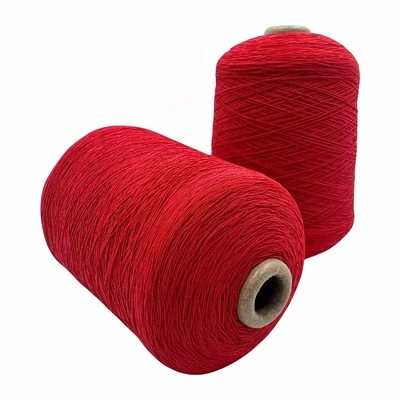
I get it, a lot of people don’t think about the yarn that goes into their clothes, but it’s the backbone of every good fabric. If the PCY is bad, the fabric is bad—no matter how nice the design is. That’s why we’re so particular about every step: from the raw materials we pick, to the tension settings, to the heat setting, to the testing. We don’t just make PCY, we make yarn that works for our customers, whatever they need. If you’re a clothing manufacturer, sock maker, upholsterer, anyone who uses PCY, and you’re tired of dealing with suppliers that cut corners or don’t deliver consistent product, hit us up to talk through your project. We can make custom PCY to your exact specs, whether it’s a small test run for a new line or a huge bulk order for a mass brand. No pressure, just let’s chat and see how we can help.
Polyester Rubber Covered Yarn References:
- Textile Institute. (2021). Yarn Manufacturing: Principles and Practice (5th ed.). Woodhead Publishing.
- Horrocks, A. R., & Anand, S. C. (2000). Handbook of Technical Textiles. Woodhead Publishing.
- Lau, A. K. L., & Wang, J. (2018). Elastic Yarns and Their Applications in Textiles. Journal of Engineered Fibers and Fabrics, 13(2), 11-20.
- Polyester Filament Yarn Association. (2022). Best Practices for Polyester Covered Yarn Production and Quality Control. Industry Technical Bulletin.
Zhuji Yuanhui Import & Export Co., Ltd.
Zhuji Yuanhui Import & Export Co., Ltd. is one of the most professional polyester covered yarn manufacturers and suppliers in China. With abundant experience, we warmly welcome you to buy high-end polyester covered yarn made in China here from our factory. If you have any enquiry about quotation and free sample, please feel free to email us.
Address: No.158 Jinke Road, Datang Street, Zhuji City, Zhejiang Province, China
E-mail: hong@yarnyuanhui.com
WebSite: https://www.yarnfty.com/
