If you’ve ever found yourself staring at a worn engine bore or a corroded hydraulic cylinder wall, and wondered whether your existing bore welder could stretch one more job before a full replacement, you’re not alone. As a bore welder supplier, I get this question at least three times a week: How difficult is it to modify a bore welder to handle a new task, accommodate a specific part size, or upgrade its weld quality? The short answer is, it depends—but the long answer, the one that matters when you’re working on a critical industrial part, is far more nuanced than most operators expect. Let’s break down what goes into modifying a bore welder, why it’s not a one-size-fits-all project, and what every shop owner, machinist, or maintenance manager should know before they grab a wrench. Bore Welder
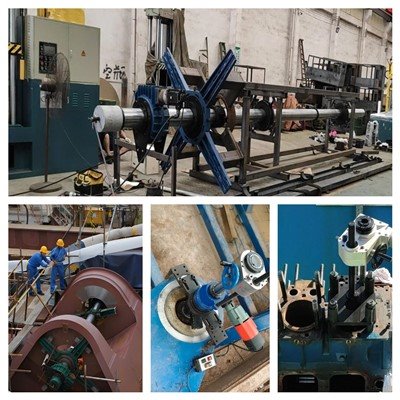
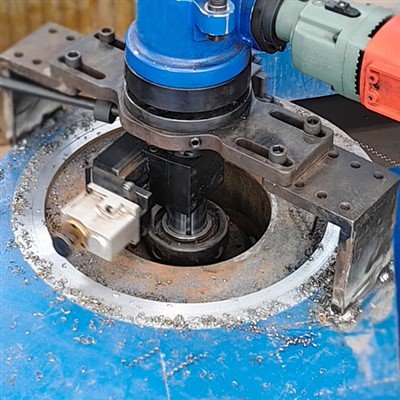
First, let’s ground this in what a basic bore welder does, because modifications only make sense when you understand the core function. A standard portable bore welder—also called a line bore welder—works by feeding a consumable wire or electrode into a narrow gap inside a cylindrical bore, while the unit’s head rotates along the bore’s centerline, depositing weld material evenly to rebuild worn metal surfaces. Most stock bore welders are designed for a narrow range of bore sizes, materials, and weld processes: for example, a common model might handle bores from 80mm to 200mm in diameter, work on cast iron or steel, and use shielded metal arc welding (SMAW) or gas metal arc welding (GMAW). But shops regularly face scenarios that don’t fit this mold: a 50mm bore on a small agricultural hydraulic cylinder that needs repair, a 300mm marine engine bore that requires thicker weld buildup, or a project that demands pulsed MIG welding to minimize heat distortion on aluminum. That’s when modifications come into play.
The first level of modification is the most common, and the easiest to pull off: parameter adjustments. Many operators don’t realize that most modern bore welders have hidden or easily accessible settings that can tweak weld current, voltage, travel speed, and rotation rate to fit slightly different jobs. For example, if you’re working on a thin-walled aluminum bore, you can adjust the machine’s heat input to avoid burning through the wall, or slow the rotation speed to let the weld pool solidify evenly. On the surface, this sounds like a simple tweak—but here’s where the difficulty starts: these settings are not universal. If your bore welder is an older, analog model, there might be no way to adjust the pulse frequency for pulsed MIG, which is critical for reducing spatter on delicate parts. Digital models often have this functionality, but only if the firmware is designed to support it, and many entry-level bore welder suppliers don’t enable all the settings in the base unit, forcing you to pay extra for an upgrade. That’s a common gotcha I see: operators assume they can just turn a dial, but in reality, half the “modifications” people think are upgrades are just hidden settings most technicians don’t know exist.
The next level of modification is mechanical, and this is where projects get complicated quickly. Let’s say you need to weld a bore that’s smaller than your unit’s minimum diameter. A stock line bore welder’s rotation head is sized for a specific range, so you can’t just shrink it down without modifying the tooling. For example, a common 100mm minimum bore line bore welder won’t fit inside a 60mm small engine cylinder, because the head’s outer casing is too large. To fix this, you might need to machine a custom insert for the rotation head, or replace the entire head assembly with a smaller one. That sounds simple, but here’s the catch: the rotation head is not a random piece of metal. It’s calibrated to maintain exact centerline alignment along the bore, and any modification that shifts the head’s center or changes its balance can cause the weld bead to be uneven, or even result in a catastrophic failure mid-weld. Last year, a customer of mine tried to machine a plastic insert for a bore welder head to save money on a small job, and the insert slipped halfway through the weld, resulting in 8mm of uneven buildup on a critical marine engine bore. They had to scrap the entire part, which cost them over $12,000 in repair time and part replacement. That’s the kind of risk that makes mechanical modifications far more difficult than most people anticipate.
Another common mechanical modification is extending the unit’s reach. If you’re working on a long bore—say, a 2-meter hydraulic cylinder for a construction crane—your stock bore welder might only have a 1-meter length of feed wire or a rotation rod. To extend it, you need to add a rod extension, but that changes the unit’s rigidity. The longer the rod, the more it can flex during rotation, which throws off alignment. For a job as precise as bore welding, where alignment within 0.1mm is required for proper operation, even a small amount of flex can ruin the weld. I’ve seen shops use flexible steel cables instead of rigid rods to get around this, but that comes with its own set of problems: cables can twist, cause inconsistent wire feed, and are not strong enough to handle high current for thick weld buildup.
Then there are process modifications, which are the most technically challenging. Let’s say your shop specializes in welding stainless steel bores, but your stock bore welder is set up for cast iron. Or you want to switch from SMAW, which is common for field repairs, to GMAW, which gives a smoother, more consistent weld for in-shop parts. Changing the process might sound as simple as swapping the electrode or wire feed liner, but it’s far more complex. For GMAW, you need a gas delivery system that’s calibrated to the unit’s rotation speed, because if the gas is flowing too fast or too slow relative to the weld head’s movement, you’ll get porosity in the weld. That means modifying the gas lines, adding a pressure regulator that can adjust flow dynamically, and recalibrating the machine’s control board to sync gas flow with rotation speed. I once worked with a mining customer who tried to switch their line bore welder from SMAW to GMAW for rebuilding track pins, and they ended up with 17 failed welds in a month because their modification didn’t account for the gas flow sync. It took us three days of testing and adjusting to get it right, and that was after they’d already wasted over $5,000 in materials.
So, putting all this together, how difficult is modifying a bore welder? The answer is that it’s only easy if the modification is small, well-researched, and done by someone with specific experience in bore welding. If you’re just tweaking digital settings to match a slightly different bore size, that’s manageable in an hour or two. If you’re modifying mechanical parts or switching weld processes, that’s a project that requires precision machining, process testing, and alignment calibration—something that can take days or even weeks, depending on the complexity. And the biggest mistake people make is underestimating the role of calibration in bore welding. A stock bore welder is calibrated at the factory for a specific set of parameters, and any modification throws that calibration off. You can’t just machine a part and expect it to work; you have to test the alignment, adjust the rotation speed, test weld samples on scrap material, and make sure the weld meets industry standards for hardness and consistency.
As a bore welder supplier, I see too many shops trying to save money by modifying their own units instead of investing in a machine that fits their exact needs. That’s not to say modifications are never worth it—for many small shops that handle a wide range of jobs, modifying a well-chosen base unit can save them from buying multiple machines. But it’s critical to be realistic about what you can do yourself, and what needs to be left to experts. For example, if you’re a small farm repair shop that does mostly small engine cylinders, modifying your existing bore welder to handle 50mm bores is possible with a custom head insert and some parameter tweaks. But if you’re a large marine repair yard that works on 300mm engine bores, modifying a standard unit to handle that size will not only be more difficult, it will likely be more expensive than buying a unit specifically designed for large-bore work.
Another point I often emphasize to customers: modifications don’t just affect your current job—they affect future ones. If you modify your bore welder to handle a specific type of job, it might not be able to handle another job down the line. For example, if you machine a head insert for 50mm bores, you might lose the ability to work on 80mm bores without replacing the insert. That trade-off is something to consider before you start any modification, because switching back later can be just as difficult as the original project.
Let me also address a common myth: many people think that portable bore welders, which are designed for on-site repairs, are easier to modify than fixed, in-shop units. The opposite is usually true. Portable units are built to be compact and lightweight, so their components are often more tightly integrated, with less room for adjustments or extensions. Fixed in-shop bore welders have more space for larger heads, longer rods, and auxiliary equipment, making modifications far simpler. That’s a key point to keep in mind when you’re choosing a machine in the first place: if you think you’ll need modifications down the line, it’s often better to invest in a base unit that has extra capacity built in, rather than trying to modify a compact portable model.
At the end of the day, modifying a bore welder is not like modifying a lawnmower or a standard welding machine. Bore welding requires an extremely high level of precision, because even a 0.1mm error in alignment can lead to a weld that wears out prematurely, or a part that fails under pressure. That’s why the difficulty of modification hinges on two things: how familiar you are with bore welding’s specific requirements, and how much the modification deviates from the factory design. Small, smart tweaks can be done in a few hours, but large, cross-process or mechanical modifications are projects that demand specialized skill and testing.
If you’re thinking about modifying your bore welder, my advice is to start with a few basic questions: What exact job do I need this modification to handle? Is there a factory setting or accessory that can do this instead of a custom modification? Can I test this modification on scrap material before using it on a critical part? Don’t make the mistake of thinking that all modifications are quick and cheap—they’re not, and the cost of a failed weld on a critical industrial part is far higher than the cost of doing the job right the first time.
Whether you’re a small shop just getting started or a large facility managing a fleet of heavy equipment, the right bore welder—whether stock or slightly modified—can make all the difference in the quality and speed of your work. If you’re ready to invest in a unit that can grow with your needs, or you have questions about whether a modification is worth your time, you can reach out to our team to discuss your specific requirements. We work with shops of all sizes, from small farm repair operations to large marine and mining facilities, to find solutions that balance your budget, your job needs, and the quality you need to stand behind every weld.
Boring Welding Reference
- Line Boring and Welding: Principles and Applications, Industrial Machining Press, 2021
- “Calibration Standards for Bore Welding Equipment”, Journal of Industrial Maintenance, Vol. 18, No. 3, 2022
- Portable Bore Welder Modification Guidelines, National Association of Machine Tool Technicians, 2020
Shangqiu JDA Machinery Technology Co., Ltd.
With abundant experience, we are one of the most professional bore welder manufacturers and suppliers in China. We warmly welcome you to buy cheap bore welder for sale here from our factory. Quality products and reasonable price are available.
Address: No. 55 Pingyuan Middle Road, Liangyuan District, Shangqiu, Henan, China
E-mail: sales@jdamachines.com
WebSite: https://www.jdamachines.com/
