If you’ve spent any time exploring warehouse automation, logistics, or manufacturing facility tech lately, you’ve probably heard two terms thrown around interchangeably: AMR (Autonomous Mobile Robot) and AIV (Autonomous Intelligent Vehicle). As someone who’s been supplying AMRs to businesses across North America for nearly a decade, I get why the mix-up happens—on the surface, both are mobile robots that move materials without a human driver. But the differences between them aren’t just semantic; they’re the difference between an automation solution that works for your daily operations and one that creates more headaches than it solves. Let me break down what sets these two technologies apart, why that matters for your business, and what that means when you’re looking to add mobile robots to your facility. Autonomous Mobile Robot
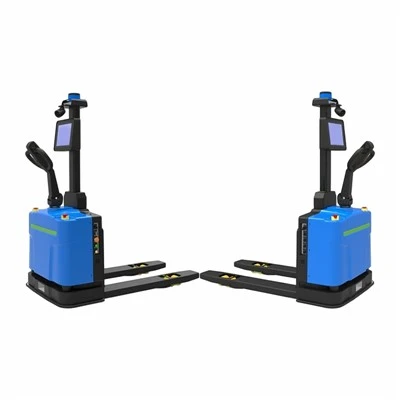
First, let’s start with the basics, because the definitions of both have evolved a lot since the first mobile robots hit industrial floors in the 1980s. Back then, AGVs (Automated Guided Vehicles) were the standard—these robots followed fixed paths, usually marked by magnetic tape or buried wires in the floor, and could only carry out pre-programmed tasks. AMRs and AIVs both grew out of attempts to make that flexibility better, but they took very different approaches.
AMRs are built on a foundation of simultaneous localization and mapping, or SLAM. That’s the tech that lets them “see” their environment: they use a combination of LiDAR sensors, cameras, and wheel odometry to build a real-time map of your facility as soon as they’re deployed. Unlike AGVs, they don’t need permanent infrastructure like tape or wires. If you rearrange your warehouse aisles, add new shelving, or move a workbench, an AMR can adapt—no need to re-map the entire space or lay new guides. They can make split-second decisions too: if a pallet jack gets in their way, they don’t stop and wait for a human to reroute them; they adjust their path to get around the obstacle, then get back on track. That autonomy is the big differentiator here. When I first started selling AMRs, most of my clients were small to mid-sized e-commerce warehouses that outgrew their AGV systems and didn’t have the time or budget to reconfigure their entire facility every few months. Those early conversations taught me that flexibility isn’t a nice-to-have—it’s a make-or-break for many operations.
AIVs, on the other hand, are often described as a step up from AGVs, but they’re not quite full AMRs. The key here is their navigation system: most AIVs rely on pre-mapped environments, usually using SLAM too, but with a big catch. They’re programmed to operate within the exact, static map you give them—no real-time adaptation for unplanned changes. If a forklift blocks their path, an AIV will stop, send an alert to a fleet manager, and wait for someone to reroute it. It can’t make that decision on its own. Some AIVs also have limitations on load capacity or terrain: many are designed for flat, smooth warehouse floors, so if you’re working in a manufacturing plant with uneven surfaces, ramps, or tight spaces, an AIV might struggle where an AMR can navigate without issues.
I see this distinction play out every single week when clients come to me confused about which solution fits. Last quarter, a automotive parts manufacturer reached out because their current AIV fleet was missing deadlines by 20% every month. Their facility had recently added a new assembly line, so the original map their AIVs used was outdated, and every time the robots hit a new stack of raw materials in an aisle, they’d get stuck waiting for a team to manually reroute them. When we deployed our AMRs, we didn’t have to redo any permanent floor markings—our team just scanned the existing space, updated the map in 2 hours, and the robots were running in their new paths the same day. Within a week, their on-time delivery rate was back up to 98%. That’s the kind of real-world impact that comes down to the AMR vs. AIV choice, not just the brand name on the robot.
But it’s not all black and white—there are use cases where AIVs make more sense, and where AMRs are overkill. For example, if you have a very small, static space with almost no changes: a 10,000 square foot retail backroom that only moves pallets between receiving and a single storage area, with no planned changes for the next 5 years. An AIV would work here—they’re cheaper to deploy upfront, and their simpler navigation means less maintenance. But if you’re a growing operation, or you have a facility that changes even a little bit every year, AMRs are worth the investment. Their ability to adapt to new layouts, obstacles, and tasks means you don’t have to replace your entire automation system every time your business evolves.
Another key difference is fleet management. AMR fleets are designed to work together seamlessly. When you have 10, 20, or 50 AMRs moving around a facility, the fleet orchestration software (the brain that controls all the robots) splits tasks between them, avoids collisions, and optimizes routes to keep everything moving efficiently. Some systems even integrate with your existing warehouse management system (WMS) or enterprise resource planning (ERP) software, so when a new order comes in, the AMR automatically knows to pick up the materials and deliver them to the packing station. AIV fleet management, by comparison, is much more basic. Because each AIV can’t make autonomous decisions, the fleet manager has to manually assign tasks and reroute robots when obstacles pop up. As your fleet grows, that becomes impossible—last year, a client with 35 AIVs told me their fleet manager was working 12-hour days just keeping the robots running, with no time for anything else. That’s a hidden cost many businesses don’t account for when they choose AIVs.
I also get asked a lot about reliability, and that’s another area where AMRs pull ahead. Because AMRs are using multiple sensors to navigate, they can handle more unexpected situations. For example, if a fluorescent light burns out above an aisle, an AIV that relies on camera vision for navigation might lose its ability to find its way, but an AMR with LiDAR can still map the space around it accurately, no lighting needed. In the cold storage warehouses we work with, where temperatures drop to -20 degrees Fahrenheit, that reliability is non-negotiable—AIVs’ sensors tend to slow down or malfunction in extreme cold, but our AMRs are built to withstand those conditions without skipping a beat. That’s not a trivial detail; for a cold storage facility, every minute a robot is down costs you thousands in spoiled inventory.
Now, let’s talk about cost, because that’s a huge factor for most businesses. At first glance, AIVs have a lower upfront cost than AMRs. But when you look at total cost of ownership (TCO) over 3 to 5 years, AMRs almost always come out ahead. Let’s break that down: upfront, an AIV might cost $15,000 per unit, while an AMR is $25,000. But with AIVs, you need to invest in permanent infrastructure if you make changes—new floor tape, updated maps, extra sensors for obstacles—and you’re paying for more labor hours to manage the fleet. A 2023 study by the Material Handling Industry Association found that businesses with AMRs saw a 30% reduction in labor costs for material handling, compared to just a 10% reduction for AIV users. Add in the fact that AMRs have a 95% uptime rate, while AIVs average around 80%, and the math swings hard in AMRs’ favor for most growing operations.
Of course, I’ll be the first to tell you that AMRs aren’t the right choice for every single business. If you’re a small bakery that only moves small trays of baked goods between the kitchen and the front counter, with no plans to expand, an AIV would work for your needs. But if you’re a 500,000 square foot distribution center processing 10,000 orders a day, or a manufacturing plant with multiple production lines that change every quarter, AMRs are the only technology that will give you the flexibility and scalability you need. I’ve had clients come to me after trying AIVs, frustrated by the inflexibility, and by switching to AMRs, they were able to double their throughput without adding a single new shift. That’s the power of choosing the right technology for your specific operations.
One thing I want to make clear: the industry is still evolving, and the lines between AMR and AIV are blurring a little. Some newer AIV models now have limited autonomous path adjustment, and some AMR systems are adding pre-mapping features to speed up deployment. But the core difference remains: AMRs are built for true autonomy, able to make decisions on their own in dynamic environments, while AIVs are designed for controlled, static environments where most changes are planned in advance. That core distinction is what you need to focus on when evaluating which solution is right for your business.
Let me share one more example to drive this home. A client in the consumer packaged goods industry reached out to me two years ago, having just invested in a fleet of AIVs. Their business was growing fast, and they were expanding their product line, which meant rearranging their storage areas every 6 months. Every time they rearranged, they had to shut down operations for 2 days to reconfigure their AIVs, costing them an estimated $15,000 in lost revenue each time. When we installed our AMR fleet, we did the map update during a lunch break, with no shutdown at all. Within a year, their total cost of downtime from automation issues dropped by $450,000—more than enough to cover the upfront difference between the two technologies. That’s the kind of ROI that makes the AMR investment worth it, even when the initial price tag is higher.
At the end of the day, choosing between AMR and AIV isn’t about picking the “cooler” technology or the lower upfront cost—it’s about aligning your automation choice with your business’s current needs and future growth plans. If you’re looking for a solution that can adapt as your business changes, reduce labor costs, improve uptime, and scale as you add more products or space, AMRs are the clear choice. If you have a small, static operation with no plans to expand in the near future, an AIV might fit. But for most of the businesses I work with, the flexibility and reliability of AMRs make them the only practical long-term solution.

If you’re in the market for mobile robots and want to learn more about which option is right for your facility, I’m here to help. We work with businesses of all sizes, from small warehouses to large manufacturing plants, to customize AMR fleets that fit your specific operations, no matter how dynamic your space is. I can walk you through case studies, break down your projected TCO, and answer any questions you have about deployment, integration with your existing systems, and support after installation. Don’t settle for a one-size-fits-all automation solution that will hold your business back—reach out to us to start a conversation about how AMRs can transform your material handling operations.
References
Autonomous Mobile Robot Material Handling Industry Association. (2023). Mobile Robotics Total Cost of Ownership Report.
International Organization for Standardization. (2020). ISO 18497:2020, Automation Systems and Integration – Mobile Robots for Industrial Applications.
Robotics Industries Association. (2022). Industrial Mobile Robot Market Trends and Analysis.
Shenzhen Ginnee Intelligent Warehousing Robotics Co., Ltd.
As one of the most professional autonomous mobile robot suppliers in China, we’re featured by quality products and low price. Please rest assured to wholesale durable autonomous mobile robot in stock here and get quotation from our factory. We also accept customized orders.
Address: Room101, No.162 JunXin Road, Niuhu Community, Guanlan Strect, Longhua District, Shenzhen, Guangdong Province, China.
E-mail: huangyongmei@szginnee.com
WebSite: https://www.ginneerobotics.com/
