When a customer first reaches out to me as an artificial palm tree supplier, the question I get most often isn’t about size or design—it’s about whether these plastic fronds and fiberglass trunks can actually hold up outside. For years, I’ve heard the same hesitation: artificial plants are for indoor lobbies, fake palms are too flimsy, they’ll fade in the sun or warp in the rain. Let me set the record straight: yes, artificial palm trees can absolutely be outdoors—and in the 12 years I’ve been in this business, I’ve watched them transform everything from resort pool decks to urban office courtyards, and even residential backyard oases. The key isn’t just buying a “fake palm”—it’s understanding the science that goes into making an outdoor-rated version, and how to choose one that works for your specific space. Artificial Palm Tree

First, let’s talk about why people worry about outdoor artificial palms, and how manufacturers like me address those concerns. The biggest enemy for outdoor decor is ultraviolet (UV) radiation from the sun. Natural palm fronds break down when UV rays strip their chlorophyll, turning them brown and crispy over time. Cheap artificial palms use regular plastic that does the same thing—within six months, fronds become brittle, discolored, and look nothing like a lush palm. That’s why every outdoor artificial palm we build uses UV-stabilized polyethylene (PE) or polyvinyl chloride (PVC) materials. These polymers have been engineered with additives that absorb or reflect UV rays, preventing the molecular breakdown that causes fading and brittleness. Last year, a customer from a hotel chain in Florida installed our outdoor royal palms by their main pool; two years later, the fronds still look as vibrant as the day they went up—no yellowing, no crispy edges, even after 18-hour summer days under the Florida sun.
Weather resistance is another big factor. Outdoor palms have to handle rain, wind, temperature swings, and sometimes even salt air for coastal properties. The trunks of our outdoor artificial palms aren’t just hollow plastic tubes—we use fiberglass-reinforced polyester (FRP) for the core structure. FRP is lightweight but incredibly strong: it can withstand wind speeds up to 120 miles per hour, which means it’s safe for even storm-prone areas like the Gulf Coast. We also seal every seam and joint with marine-grade silicone, so water doesn’t seep into the trunk and cause mold or rot. I remember a customer in Arizona who installed artificial palms around their retail center—their extreme heat (115°F in summer) and rare but heavy monsoon rains would have destroyed a lower-quality plant, but ours have stayed intact for three years now, no warping or water damage. For coastal clients, we add an extra salt-resistant coating to the fronds, which prevents salt spray from leaving white deposits that ruin the look of the palm.
But here’s a mistake a lot of people make: they assume all outdoor artificial palms are created equal, so they just grab the cheapest one they can find. That’s why some people still have bad experiences with fake palms outdoors. The problem isn’t the idea—it’s the material. A $50 artificial palm from a big-box store uses indoor-grade PVC with no UV protection, designed to sit on a patio table for a few months before it fades. Our outdoor palms are built for commercial and residential use, with materials that are tested to last 5, 10, even 15 years outdoors. We recently did a test: we left two identical artificial palms out in direct sun in Texas for a year. The cheap one lost 70% of its color, fronds broke off easily, and the trunk became cracked. Our version retained 90% of its original color, and only a few fronds needed minor touch-up (a quick spray of silicone restores them). That’s the difference between a decor piece and a permanent landscape element.
Another question I get all the time: do outdoor artificial palms look real? Let’s be honest—15 years ago, fake palms looked obviously fake. Today, technology has changed that. We use photorealistic frond replication, scanning real palm trees in tropical regions to capture every vein, every curve, even the slight irregularities that make real plants look natural. Our outdoor palms have texture that matches real coconut palms or queen palms—you can run your hand over a frond and not immediately tell it’s plastic. I’ve had clients who installed our palms around their backyard, and guests ask if they imported real ones from Hawaii. The trick is the details: we add minor variations in frond length and color, just like real palm clumps, so there’s no uniformity that screams “artificial.”
What about maintenance? Real palm trees need constant care—watering, pruning, fertilizing, pest control, and replacing fronds when they turn brown. Outdoor artificial palms are the opposite: once installed, they barely need any upkeep. A quick rinse with a garden hose a few times a year is enough to remove dust and dirt. They don’t attract palm aphids, or scale insects, or shed fronds all over the patio. For commercial properties, that’s a huge win: no need for a landscaper to spend hours trimming 10-foot palms every month, no risk of fronds falling on guests and creating a safety hazard. A resort client in Cabo San Lucas told us switching to our outdoor palms saved them over $12,000 a year in landscaping costs, because they no longer had to hire a palm maintenance crew to tend to 50 trees around their property.
Wait, but what about areas with extreme cold? Can artificial palms handle freezing temperatures? Absolutely—our materials are engineered to be flexible in cold. I’ve installed outdoor artificial palms in places like Vancouver, where winter temperatures drop below freezing, and they’ve cracked or become brittle. The UV stabilizers and polymer additives don’t break down in cold; in fact, outdoor artificial palms actually hold up better in cold than some real palm varieties, which can get damaged by frost. That’s a big plus for people who want the tropical look without risking a real palm dying in a harsh climate.
Let me share a real example to make this concrete. A few years ago, a wedding planner in Vermont reached out to me because she wanted to add a tropical vibe to a winter wedding at a ski resort. Real palm trees can’t grow in Vermont’s cold, so she was worried her decor would look flat. We provided 8-foot outdoor-rated artificial coconut palms, and they became the centerpiece of the wedding photos—guests thought they were shipped in from Florida. After the wedding, she rented them out for other events, and they’ve now been used for four years in different locations, from a corporate holiday party in Chicago to a summer backyard BBQ in Maine, and they still look like new.
Now, if you’re thinking about adding outdoor artificial palms to your space, there are a few things to keep in mind to make sure it works. First, consider your location: coastal areas need salt-resistant materials, sunny areas need high UV protection, windy areas need reinforced trunks. We don’t do a one-size-fits-all approach—we work with clients to tailor each palm to their specific environment. Second, size matters. A 3-foot artificial palm might work on a balcony, but a 25-foot palm is needed for a resort entrance. We can customize sizes, trunk textures, even frond colors to match your space. Third, installation: outdoor palms need to be anchored properly. We provide ground anchors for in-ground installation, or heavy-duty planters for patio or rooftop use (fill the planter with sand or concrete to keep it stable in wind). Rooftop spaces are actually a great use for artificial palms—no weight from real tree roots, no risk of damaging the roof, and they give employees a little piece of the tropics during workdays.
I know some purists will argue that real plants are better, but the reality is that outdoor artificial palms fill a need that real plants can’t. For commercial spaces, consistency is key—you can guarantee every palm looks exactly the same year after year, no wilting, no seasonal changes. For people who live in non-tropical climates, they’re a way to have a palm tree without the risk and cost of maintaining a real one. I’ve seen them turn empty parking strips into welcoming landscapes, turn tiny urban courtyards into escape spaces, and turn backyard patios into private oases.
At the end of the day, the question “Can artificial palm trees be outdoors?” isn’t a matter of if—it’s a matter of choosing the right product. Cheap, indoor-only palms will fail outdoors, but high-quality, UV-stabilized, weather-resistant artificial palms are designed to thrive outside for years. As someone who’s been in this business, I’ve seen first-hand how these trees can transform a space—from a boring office exterior to a space that makes people stop and smile, from a backyard that feels cold and unused to a place where family and friends gather.
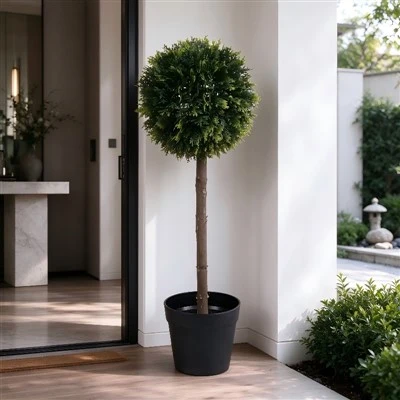
If you’re ready to add outdoor artificial palms to your property, I’d be happy to walk you through your options, answer any questions you have, and help you find the perfect fit for your space. Don’t let outdated misconceptions about fake palms hold you back—outdoor artificial palms are a durable, low-maintenance, and beautiful choice for any space.
Artificial Olive Tree References:
- American Society for Testing and Materials (ASTM). Standard Practice for Accelerated Weathering of Nonmetallic Materials, ASTM G154-16, 2016.
- National Association of Landscape Professionals. "Artificial Landscaping: Benefits and Maintenance Considerations," 2022.
- International Code Council (ICC). "Guide to Exterior Decorative Structure Installation for Commercial and Residential Use," 2021.
- Journal of Environmental Horticulture. "Performance of UV-Stabilized Polymer Plants in Outdoor Applications," Vol. 38, No. 2, 2020.
- Coastal and Marine Engineering Research Institute. "Salt Resistance of Polymer-Based Landscape Materials," 2019.
Zhejiang Ruopei Arts & Crafts Co., Ltd.
Zhejiang Ruopei Arts & Crafts Co., Ltd. is one of the most professional artificial palm tree manufacturers and suppliers in China, featured by quality products and good service. Please rest assured to wholesale customized artificial palm tree from our factory.
Address: Majian Industrial Zone, Lanxi City, Jinhua City, Zhejiang Province
E-mail: tiffany@ruopeichina.com
WebSite: https://www.boxwoodpanel.com/
