Hey there! I’m a supplier in the backyard artificial turf game, and I’m super stoked to walk you through the installation process. It might seem a bit daunting at first, but trust me, with a little know – how, you’ll have a lush, green backyard in no time. Backyard Artificial Turf

Step 1: Planning Your Project
Before you even think about laying down that turf, you gotta plan. First off, measure your backyard. I can’t stress this enough. You need accurate measurements to order the right amount of turf. Grab a tape measure and get to work. Measure the length and width of the area where you want to install the turf. Don’t forget to account for any odd shapes or curves. If your backyard has a funky layout, break it down into smaller, more manageable rectangles or squares and measure each one separately.
Once you’ve got your measurements, it’s time to think about the design. Do you want a simple, all – over green look? Or are you thinking about adding some borders or patterns? Maybe you want to create a putting green or a play area. Sketch out your ideas on a piece of paper. This will help you visualize the final result and make sure you have everything you need.
Step 2: Preparing the Ground
Now, the groundwork is crucial. You can’t just lay turf on any old surface. First, you need to clear the area. Get rid of all the grass, weeds, rocks, and debris. You can use a shovel, a rake, or a sod cutter if you’ve got a large area. Make sure the ground is as clean as possible.
After clearing, you’ll want to level the ground. Uneven ground can make your turf look bumpy and uneven, and it won’t drain properly either. Use a leveling rake to smooth out the surface. If you have low spots, fill them in with topsoil or crushed rock. If there are high spots, use the rake to scrape them down.
Next up is compacting the soil. You can use a hand tamper for small areas or a plate compactor for larger ones. Compacting the soil will give your turf a solid base to sit on and prevent it from shifting or sinking over time.
Step 3: Installing the Geotextile Fabric
After leveling and compacting the soil, it’s time to lay down the geotextile fabric. This stuff is like a protective barrier between the soil and your turf. It helps prevent weeds from growing through the turf and also improves drainage.
Unroll the geotextile fabric over the prepared ground. Make sure it covers the entire area where you’ll be installing the turf. Overlap the edges of the fabric by about 6 inches. You can use landscape fabric pins to hold the fabric in place. Just stick the pins through the fabric and into the soil every few feet along the edges and in the middle.
Step 4: Adding the Base Material
Now, we’re adding the base material. This is usually a layer of crushed rock or decomposed granite. The base material provides stability and drainage for your turf.
First, spread a layer of base material over the geotextile fabric. The thickness of the layer depends on the type of turf you’re installing and how you’ll be using the area. For most residential backyards, a 2 – 3 inch layer is usually sufficient.
Use a rake to spread the base material evenly over the fabric. Then, use a compactor to compact the base material. You’ll want to make several passes with the compactor to make sure the base is solid and level. Check the level frequently with a level tool to make sure the base is perfectly flat.
Step 5: Laying the Artificial Turf
This is the exciting part! Unroll your artificial turf over the prepared base. Start at one end of the area and roll the turf out towards the other end. Make sure the turf is aligned correctly and that there are no wrinkles or folds.
If you have multiple pieces of turf, you’ll need to seam them together. Overlap the edges of the two pieces of turf by about 2 inches. Use a turf seam tape and a turf adhesive to join the pieces. Apply the adhesive to the seam tape, then place the seam tape under the overlap of the turf. Press the turf down firmly onto the seam tape to seal the joint.
Step 6: Trimming the Turf
Once the turf is laid and seamed, it’s time to trim it. Use a sharp utility knife or turf cutter to trim the edges of the turf to fit the perimeter of your backyard. Cut along the edges of the area, making sure the turf is flush with the boundaries.
You may also need to trim around any obstacles, like trees, flower beds, or walkways. Just take your time and make precise cuts.
Step 7: Infilling the Turf
Infilling is an important step that helps the turf stand up straight, provides cushioning, and improves drainage. There are different types of infill materials available, such as silica sand, rubber granules, or cork.
Use a broadcast spreader to spread the infill material evenly over the turf. Start with a small amount and gradually add more as needed. Use a stiff broom to brush the infill into the turf fibers. Make sure the infill is evenly distributed and that it reaches the base of the turf.
Step 8: Brushing the Turf
After infilling, give the turf a good brushing. This will help the turf fibers stand up straight and look more natural. Use a power broom or a stiff brush and brush the turf in different directions.
Brushing also helps to further distribute the infill material and ensures that the turf is well – settled.
Step 9: Final Inspection
Once you’ve completed all the previous steps, it’s time for a final inspection. Walk around the area and check for any loose seams, uneven areas, or missing infill. Make any necessary adjustments.
Check the edges of the turf to make sure they are secure and that the turf is not pulling away from the perimeter. Look for any signs of damage or wear and tear.
And there you have it! You’ve successfully installed backyard artificial turf. It’s a lot of work, but the end result is totally worth it. You’ll have a beautiful, low – maintenance backyard that you can enjoy year – round.
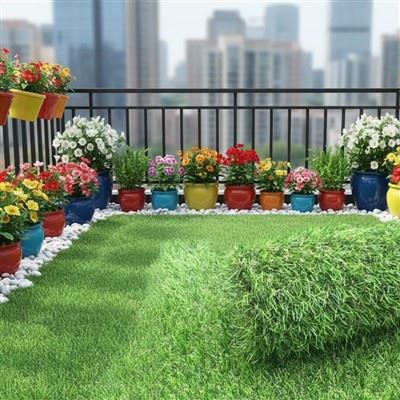
If you’re thinking about sprucing up your backyard with artificial turf, I’m here to help. Whether you need advice on the installation process, want to know more about the turf products we offer, or are ready to place an order, feel free to reach out. We can discuss your specific needs, answer all your questions, and help you get the perfect artificial turf for your backyard. Let’s turn your outdoor space into a dreamy oasis together!
Rooftop Artificial Turf References
- "Artificial Grass Installation Manual", Industry standard guidebook
- "Backyard Makeovers with Artificial Turf", Gardening magazine article about turf installation in backyards
- "Tips for a Successful Turf Installation", Personal experience from long – term artificial turf installers
Yiwu Duofu Artificial Flower Co., Ltd.
As one of the most professional backyard artificial turf manufacturers and suppliers in China, our products have good reputation in the market. Please feel free to wholesale bulk custom made backyard artificial turf from our factory. Good service and quality products are available.
Address: Building B, No. 566 Chunhua Road
E-mail: 13373813738@aliyun.com
WebSite: https://www.chinaturffactory.com/
