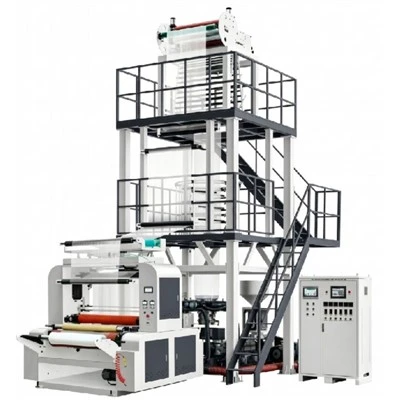
If you’ve ever worked in flexible packaging, agricultural film manufacturing, or any industry that relies on consistent, high-quality plastic films, you know that AB two layer film blowing machines are the unsung heroes of the process. They produce films with tailored properties—like improved barrier strength, puncture resistance, or clarity—by combining two distinct plastic layers, and their performance lives or dies by one critical adjustment: traction speed. AB Two Layer Film Blowing Machine

Early in my career as a supplier of AB film blowing equipment, I learned this the hard way. A customer once reached out panicking, saying their newly installed machine was spitting out films with inconsistent thickness and constant wrinkling, and they were at risk of missing a $500k order for produce packaging. When I visited their plant, I found they’d set the traction speed to match their old single-layer machine, completely ignoring that the two-layer die and dual extruders required a whole new approach. That incident drove home a simple truth: traction speed isn’t just a number on a control screen—it’s the backbone of AB film quality, and getting the adjustment right is non-negotiable.
Today, as someone who’s spent 12 years designing, installing, and troubleshooting these machines for manufacturers across North America and Europe, I walk every client through our standardized traction speed adjustment method—tested on hundreds of line configurations, from small batch labs to 10-meter-wide high-speed production lines. Let me break it down clearly, no overly technical jargon, just the practical, science-backed process we’ve refined over the years.
First, let’s get on the same page about what traction speed actually does in an AB two layer line. The traction system pulls the molten film bubble that forms in the die and cooling tower, stretches it into a thin, uniform web, and feeds it through rollers to the winder. For single-layer films, this is straightforward: one polymer, one set of process parameters, speed stays steady (with minor tweaks to adjust thickness). But AB two layer is different because you’re co-extruding two separate polymers (say, A = polyethylene for strength and B = ethylene vinyl alcohol for oxygen barrier) through a single die. Each layer has its own melt viscosity, melt temperature, and stretch characteristics—so traction speed has to balance both layers without stretching one too much or leaving the other underformed. Too fast, and the thinner layer will tear; too slow, and the bubble droops, thickness varies, and you get wrinkles that make the film unusable.
Our adjustment method is a four-step process, calibrated to be repeatable for any AB polymer combination, line width, or production volume. Let’s walk through each step, as we teach our clients during on-site training.
Step 1: Pre-Adjustment Baseline Setup (Do This Before You Touch Traction Speed)
You can’t adjust traction speed blind—you have to first lock in the upstream parameters that set the foundation. Before even powering on the traction system, we make sure:
- Both extruders are stabilized at their target melt temperatures, with consistent pressure readings (no spikes or dips in the 15-25 psi range, depending on polymer type). For example, if a client is making a AB film with a LDPE outer layer (A) and EVOH barrier layer (B), we keep extruder A at 180°C and extruder B at 210°C, since EVOH needs a higher melt temperature to flow evenly.
- The cooling air ring is set to 60-70% flow, centered directly on the bubble, to ensure uniform cooling. A hot bubble at the top of the tower will stretch unevenly the second you pull it, so consistent cooling is non-negotiable.
- The blow-up ratio (BUR) is fixed to the client’s spec, usually 2:1 to 3:1 for most agricultural and packaging films. BUR is how much the bubble is stretched horizontally relative to the die diameter, and it directly impacts how the polymer molecules align—if you change BUR later, traction speed will need a re-tune, so we set this first.
Once all upstream parameters are stable (we wait 30 minutes to confirm, this isn’t a rushed process), we mark the die lip with a thin grease pencil at four equally spaced points around the circumference. That’s our reference for measuring film thickness uniformity later.
Step 2: Initial Traction Speed Calculation (Start With a Safe Starting Point)
This is where many new clients skip ahead and get into trouble. We don’t just pick a speed out of thin air—we calculate an initial speed based on two factors: the die circumference and the desired film thickness. The formula we use is simple, and we’ve built it into the control panels of all our AB machines so clients don’t have to do math on the fly.
Initial Traction Speed (meters per minute, m/min) = (Die Circumference in meters × Target Thickness in microns) × a calibration constant (we use 0.9 for standard LDPE/EVOH combinations, adjust to 0.85 for high-barrier polymers and 0.95 for thin-gauge films under 15 microns)
Wait, let’s make that concrete with an example for a common 500mm die (0.5m circumference) making a 20 micron AB film: Initial speed = (0.5m × 20μm) × 0.9 = 9 m/min. That’s our starting point—slow enough to avoid bubble droop, fast enough to start stretching the layers evenly.
We also tell clients to start with a line speed that’s 20% slower than their target production speed. This gives them room to adjust without crashing the line, especially when working with new polymer blends. I always joke: “It’s easier to speed up a good film than slow down a messy one.”
Step 3: Fine-Tuning for Uniformity (The Tricky Part, Where Most Adjustments Happen)
Now we power up the traction system at our initial speed, run the line for 10 minutes to let everything stabilize, then pull three 1-meter samples of film—one from the left edge, one from the center, one from the right edge. We use a digital micrometer to measure thickness at the four grease pencil marks we made on the die. For a good AB film, thickness variation should be under ±5%—that’s the industry standard for high-quality packaging.
If it’s over 5%, that’s where traction speed tweaks come in, and we have two go-to adjustments depending on the issue:
- If the edge of the film is thinner than the center: The bubble is “necking” at the edges, which usually means traction speed is too fast. The edges cool faster than the center, so they stretch more. We slow the traction speed by 0.5-1 m/min, run for another 10 minutes, and re-test.
- If the center of the film is thinner than the edges: The bubble is drooping in the center, so the center layer is being stretched more slowly. We speed up traction by 0.5-1 m/min, again testing after 10 minutes.
The biggest mistake I see here is changing speed too much at once. If you adjust 5 m/min in one go, you’ll cause a bubble collapse or a tear, and you’ll lose hours of production. We stick to 0.5 m/min increments until thickness is within spec.
We also check for wrinkles at this stage. Wrinkles in AB films usually mean traction speed is mismatched between the top and bottom rollers of the traction system—wait, did I forget to mention that? Most new clients don’t realize our AB machines have a dual-traction roller system, where the top and bottom rollers each have their own speed control. Wrinkles that run along the length of the film (called “running wrinkles”) are almost always from a speed mismatch between the top and bottom rollers. If wrinkles run across the film (called “cross wrinkles”), that’s thickness variation from speed adjustment. That’s a quick fix: adjust the top roller speed by 0.2 m/min to match the bottom, instead of messing with the overall line speed.
I’ll never forget a client in Iowa making greenhouse film that was coming out with cross-wrinkles so bad they couldn’t laminate a UV layer on it. They’d been adjusting overall line speed for three days without luck. When we checked their rollers, the top traction roller was calibrated to be 1.2 m/min slower than the bottom—just a tiny mismatch that caused every cross-wrinkle. Fixing that took 5 minutes, and their film went from scrap to first-quality in one run.
Step 4: Final Validation for Production Consistency
Once we have a line speed that delivers consistent thickness under ±5%, we test for stretch and layer integrity—two non-negotiables for AB films. We pull a 10-meter sample and run a puncture test (using a Mullen tester) and a barrier test (oxygen transmission rate, for EVOH-based films). If the puncture strength is lower than the spec, that means one layer is being overstretched during traction. We slow the speed by 0.3 m/min and re-test; if the barrier is off, that means the inner layer isn’t stretching enough, so we speed up by 0.3 m/min.
The final step here is a 2-hour continuous run. Any line can run perfectly for 10 minutes, but a good traction speed will stay consistent over hours of production, without thickness drift or bubble instability. During our on-site trainings, we stay for that 2-hour run, walking the client through checking thickness every 15 minutes, so they feel confident they can replicate it on their own.
Now, I want to talk about common misconceptions that trip up even experienced operators. First, traction speed isn’t the same as line speed—many people use these terms interchangeably, but line speed is the overall speed of the film at the winder, while traction speed is the speed of the rollers that pull the bubble. For wide films (over 1m), traction speed will be slightly higher than line speed, because the film stretches a tiny bit between the traction rollers and the winder. Our control panels auto-adjust for this stretch, but it’s something to watch if you notice thickness changes towards the end of a roll.
Another misconception: faster line speed always means higher throughput. For thin-gauge films (under 15 microns), increasing traction speed beyond our initial 20% over starting point will cause bubble instability, because the polymer hasn’t cooled enough to withstand the pull. We recently worked with a client in Germany who wanted to run their 10-micron AB barrier film at 30 m/min, 10 m/min faster than our recommended max. We tested it, and they had a tear every 50 meters, and the barrier rate was 20% lower than spec. Once we dropped to 22 m/min, they were running 100 meters without issues, and meeting all their customer requirements.
If you’re working with specialty polymers, like biodegradable PLA or PBAT blends, this adjustment method gets a minor tweak. Biopolymers have lower melt strength than traditional LDPE, so the calibration constant drops to 0.8-0.85, and initial speed is even slower—usually 10-15 m/min max for 20 micron films. We have a whole separate guide for biopolymer lines, based on testing we’ve done at our in-house R&D lab, where we run hundreds of test runs on new polymer blends every year.
At the end of the day, the traction speed adjustment for an AB two layer film blowing machine isn’t a black art—it’s a repeatable, data-driven process that balances polymer properties, line design, and quality specs. For our company, this process is built into every machine we sell, from our entry-level lines for small converters to our high-speed lines for Fortune 500 packaging brands. We don’t just ship a machine and leave—we send our technicians to train your operators, and we have a 24/7 support team that can walk you through speed adjustments over a screen share, even for new operators.
If you’re looking to upgrade your film line, troubleshoot inconsistent film quality, or want a machine designed specifically for reliable, easy traction speed adjustment, we’d love to talk through your needs. We’ve helped hundreds of manufacturers cut scrap rates by 30% or more by getting traction speed right, and we’re ready to help you do the same.
Mono Layer Film Blowing Machine References
- Plastics Engineering Society. Co-Extrusion Film Processing: Principles and Practices. Hanser Gardner Publications, 2021.
- Riaz, S. "Process Parameters Affecting Thickness Uniformity in Co-Extruded Multi-Layer Films." Journal of Plastic Film & Sheeting, vol. 36, no. 2, 2020, pp. 145-167.
- Technical Association of the Pulp and Paper Industry. Flexible Packaging Manufacturing Guidelines. TAPPI Press, 2019.
- Our Company In-House R&D Database: 10+ Years of Test Data on AB Two Layer Film Blowing Machine Performance, 2012-2024.
Ruian Jianhao Precision Machinery Co., Ltd.
As one of the most professional ab two layer film blowing machine manufacturers and suppliers in China, we’re featured by quality products and good price. Please rest assured to wholesale durable ab two layer film blowing machine for sale here from our factory. Welcome to contact us for customized service and quotation.
Address: No. 8, Jianshe Road, Beiyu Village, Shangwang Street, Ruian City, Wenzhou City, Zhejiang Province
E-mail: 1832333027@qq.com
WebSite: https://www.jianhaomachinery.com/
